





How Much Does It Cost to Charge An Electric Car? (2026)
Charging your electric car can cost as little as 6.18p per kWh at home, all the way to 89p per kWh in public, depending on where you charge, your battery size, and your routine. Home EV charging is the cheapest way to charge your electric car, even more so when coupled with a smart EV charger and a special EV-driver-specific tariff. For example, you can fully charge for roughly £14 at home, or top up with an EV tariff for as little as £4.
Charging an electric car is cheaper than fuelling petrol and diesel cars, especially given the current state of affairs. In fact, lower fuel costs are one of the main reasons why people are making the switch to electric. Now, over 2,280,000 EVs roam UK roads – and that number’s only going up.
But where and how you charge your electric car impacts how much it costs to charge.
Today, we cover everything you need to know about EV charging costs, including how much it costs to charge at home, at home with EV tariffs, in public, and how you can slash your charging costs.
Spoiler: Home EV charging with a smart EV charger is – and will always be – the cheapest way to charge your car, in some cases for as little as 6.18p per kWh with an EV tariff.
Quick summary:
- Across the board, you’re looking at £2.99 to £5.40 to charge your electric car during off-peak hours with an EV tariff. However, it varies depending on which you choose – and which you qualify for.
- Public EV charging stations are the most expensive way to charge your electric car. Estimating, you’re looking at between 39p and 89p per kWh at public charging stations, depending on the speed and the chargepoint operator.
- To work out how much it costs to charge your electric vehicle, use the formula: cost to charge = battery size (kWh) x electricity price (per kWh). Or take advantage of our EV Charging Cost Calculator for instant answers.
Last updated: October 2026
1. How much does it cost to charge an electric car at home?
The cheapest way to charge your EV by a mile: at home. From the moment your smart EV charging point is installed, you can charge more cheaply and more sustainably. But exactly how you charge your EV at home has a direct correlation with your EV charging costs.
Let’s break home charging costs down.
Charging at home with a standard electricity rate:
Since 1st October 2026, the electricity rate is set at 26.32p per kWh. So, how much does it cost to charge an electric car at home with a standard electricity rate? Let’s lift up a magnifying glass:
EV Model |
Battery size |
Cost for a full charge (0 to 100%) |
| Tesla Model 3 | 60 kWh | £15.79 |
| Kia EV3 | 58.3 kWh | £15.34 |
| Audi Q6 e-tron | 94.9 kWh | £24.97 |
Charging at home with an EV tariff:
Designed specifically for electric car drivers, EV tariffs offer cheaper, greener EV charging during off-peak hours. With these tariffs, you pay two different rates: one during peak hours and the second, a discounted rate during off-peak hours (overnight, typically between 11 pm and 5 am).
With a standard EV tariff, you’ll simply pay the same amount whenever you go to charge, day or night.
EV Tariff |
Off-Peak Rates (per kWh) |
Charging Window |
Rough overnight charging cost |
Available in 2026 |
| Intelligent Octopus Go | 7.6p | 11:30 pm to 5:30 am | £4.80 | Yes |
| British Gas EV Power | 9.5p | 12:00 to 5:00 | £5.40 | Yes |
| E.ON Next Drive Smart EV Tariff | 8.1p | 12 am to 6 am | £4.80 | Yes |
| OVO Charge Anytime | Variable rate | Changes | N/A | Yes |
| ScottishPower EV Saver Tariff | 8.5p | 12 am to 5 am | £2.99 | Yes |
| EDF GoElectric | 6.66p | 11 pm to 6 am | £4.89 | Yes |
| EDF Pod Power | 6.18p | 11 pm to 6 am | £4.54 | Yes |
| Ecotricity | 8p | 12 am to 5 am | £4 | No |
| Good Energy | 8p | 12 am to 5 am | £4.25 | Yes |
| So Energy | 7.5p | 12 am to 5 am | £4.40 | Yes |
How do I charge my electric car with an EV tariff?
To take advantage of a special EV tariff, you usually need:
- A smart EV charger installed at home
- A smart meter installed at home that is capable of half-hourly meter readings
- An electric vehicle
- To pay for your electricity via direct debit
Good to know: Not all smart EV chargers are compatible with all EV tariffs. Certain electricity tariffs require a specific smart charger. EDF Pod Power, for example, requires a Pod home charger.
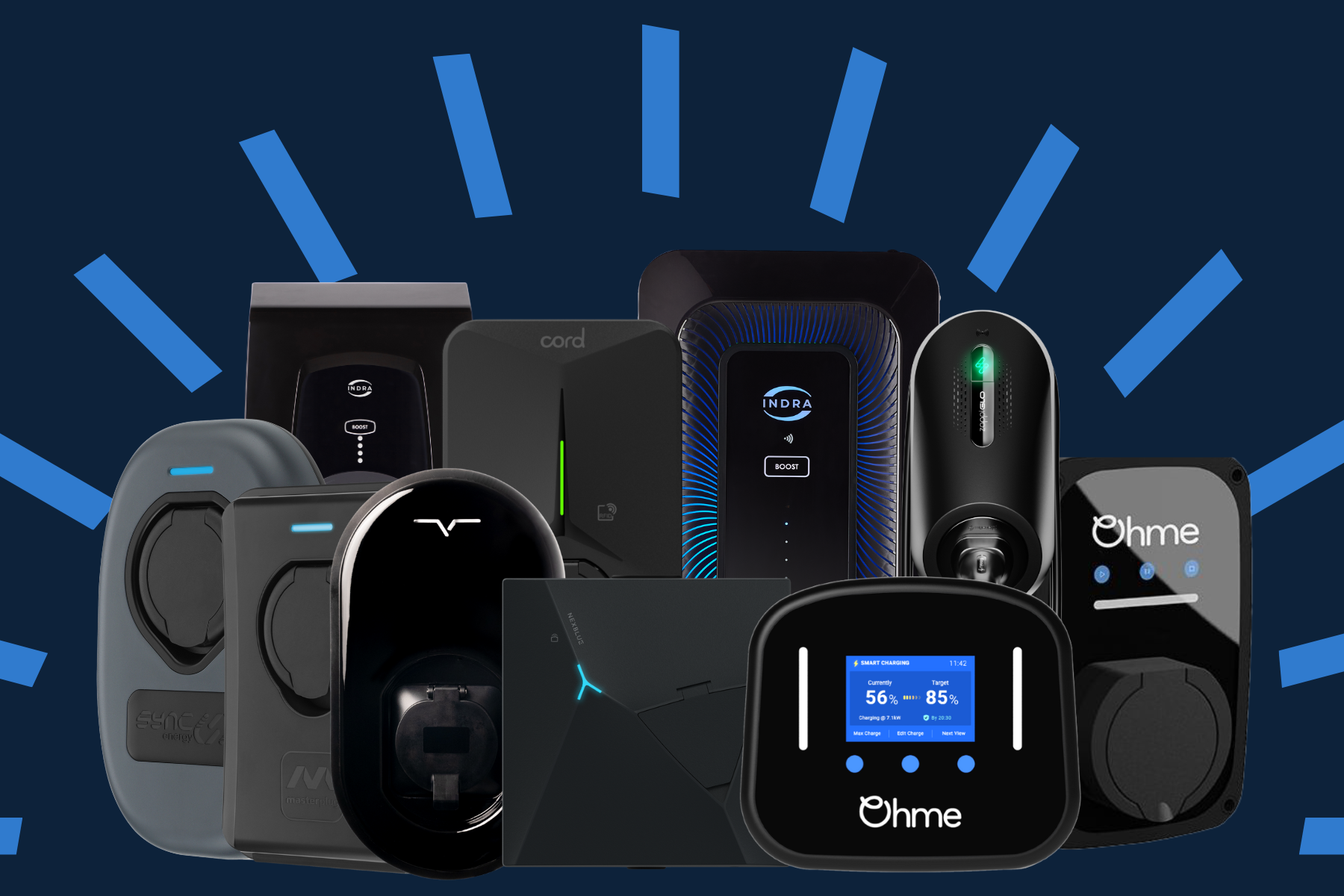
Many of the UK’s best EV chargers come with tariff compatibility, especially the Ohme Home Pro and Ohme ePod.
However, if you have your eye on a specific EV tariff, make sure you read the fine print and invest in a compatible EV charger. Otherwise, you won’t be able to take advantage.
2. How much does it cost to charge an electric car in public?
Charging your electric car in public – supermarkets, restaurants, car parks, motorways – is significantly more expensive than the home charging route. Usually double, if not triple, the price.
Of course, some public charging stations offer faster charging points, meaning you can charge quicker at a higher price, but for less time. A rapid charging point, for example, can cost 70-80p per kWh, but take 20 minutes to charge your EV to 80%.
As a general rule of thumb, Zap-Map have estimated around 54p per kWh for 3kW to 49kW charging points and 77p per kWh for public chargers over 50kW.
For the full range of manufacturers’ and operators’ pricing, please consult our table below.
Operator |
Cost per kWh |
| BP Pulse |
|
| Char.gy |
|
| Shell Recharge |
|
| Osprey |
|
| Mer Charging Network | Guest rates
Mer Members
|
| Instavolt |
|
| ChargePlace Scotland |
|
| IONITY |
|
| GRIDSERVE |
|
| Pod |
|
How much does it cost to charge an electric car at a supermarket?
EV charging costs vary depending on where you do your weekly shop. Below, find a summary of UK supermarket EV charging prices.
Supermarket |
Cost per kWh |
| Sainsbury’s |
|
| Aldi |
|
| Tesco |
|
| Lidl |
|
| Asda |
|
What are the key factors that impact EV charging costs?
1. Battery size
The bigger the battery, the more it will cost to fill. Simple maths.
Small electric cars have their perks, and smaller costs are one of them.
2. EV charger speed
Faster usually equals more expensive. Ultra-rapid charging points cost more per kWh than charging at home with the typical 7kW power output.
3. Where you charge
Public charging stations are point-blank more expensive than home EV charging. It’s a fact.
At 76p per kWh at ultra-rapid charging stations against 7.6p per kWh during off-peak hours with Intelligent Octopus Go.
4. Electricity price
A standard rate tariff or special EV tariff, whichever you choose, will have a knockback effect on your costs.
You could save up to 300% with an EV tariff compared to the current electricity rate.
5. What time you charge
Charging overnight during off-peak hours is the goldmine of untapped electricity, and in turn, cheaper costs.
On the other hand, peak evening rates when everybody is back from work and school, and you’ll see electricity prices rise.
How can I reduce my electric car charging costs?
1. Use free EV charging points
In 2026, it’s unlikely you’ll see a shiny free charging point when out and about. Like all things rare, you’ll have to seek them out.
Make use of handy, popular apps, such as Zap-Map and PlugShare, and hunt down free EV chargers near you.
RELATED: Where Can I Charge my Electric Car for Free in Public?
2. Charge at your workplace
As EV adoption infiltrates the UK, many workplaces are choosing to offer EV charging facilities as an employee benefit.
Whether this is free or subsidised EV charging, make sure you plug in when you get to work and charge for less. It’s more time-efficient, too.
No smart EV charger at home? No longer do you have to queue to charge at public charging stations on the way home. Plug in, work, leave. Simple.
With or without a home EV charger, your everyday charging costs plummet.
3. Install a smart EV charger at home
Not only are smart EV chargers the best way to save on your EV charging costs, but they also maximise convenience. Park up. Plug in. Charge. No waiting. No queues.
Of course, to install an EV charger at home, you need to meet the requirements.
4. Take advantage of EV tariffs
As mentioned earlier, EV tariffs are a surefire way to slash your EV charging costs.
Charge for as little as 7.6p per kWh with popular EV tariffs, such as Intelligent Octopus Go.
Or, if you’re eligible, charge for as little as 6.66p with EDF. Although the criteria are much tighter.
5. Solar electric car charging
Smart EV chargers often come pre-baked with solar EV charging. The Zappi Glo is one of the most renowned in the charging world. And for good reason.
If you have a solar PV system (solar panels), combine discounted EV tariff charging overnight and free, surplus solar energy with solar charging, and the savings will roll in hot and fast.
Incorporate battery storage into your charging routine, store excess solar energy, and use it at a later date to top up for even lower charging costs.
6. Limit public charging stations
Only use public chargers when you need to. Picture before a long cross-country route, or if you’re in desperate need of a top-up and you’re far from home. This is fine. And often, necessary.
Frequently using these public charging points, though? You’ll damage your EV battery and your bank account. You pay a premium in public.
7. Make use of EV charging offers
Key players in the EV charging game occasionally provide offers, including credit or discounts.
Here are a few:
- Vauxhall: Receive £500 off public charging when you purchase a Vauxhall EV.
- For Hive EV charger owners, you get £20 credit to spend with Zapmap.
8. EV charging cards (RFID)/ memberships
Instead of having a slow, jam-packed phone filled with network apps, consider an EV charging card (sometimes referred to as an RFID card) along with network memberships.
A variety of cards are available, each with its own benefits and rewards that make your public charging easier – and usually cheaper with discounted public charging rates. Ideal if you have on-street parking and make use of public charging networks on the regular.
Most have loyalty programs, too, where you can accumulate points and use them on your EV charging. Sainsbury’s Smart Charge, for one, let you earn Nectar points with each charge, which you can use later on your weekly shop.
Let’s take a look at some more of our favourite options:
- Octopus Electroverse, for example, allows you to save money through discounts, benefits and plunge pricing. Plus, if you’re an Intelligent Octopus Go customer, you get 8% off public charging, or 5% with Octopus Go. Ideal for those emergency situations where you need to charge with public charging stations.
- Shell: Get 30% off on Shell EV charging with a Shell Recharge card.
- BP Pulse: Get 20% off BP Pulse charging stations with their charge card. Plus, get half-price hot drinks at Wild Bean Café with your subscription.
9. EV charger sharing
Haven’t had a chance to install an EV charger yet? Waiting on DNO approval? Investing in a cross-pavement solution because you have on-street parking? Don’t miss out on cheaper electricity.
Download CoCharger, and see if any of your neighbours are renting out their home EV charger. You’ll find it’s cheaper than visiting your local public charging point.
How much does it cost to charge an EV? Different size-electric car examples:
Small electric car charging costs:
EV Model |
Battery size |
Cost for a full charge at home (26.32p per kWh) |
Cost for a charge with an EV tariff (7.6p per kWh) |
Cost for a 20-80% charge in public (76p per kWh, 60 kWh) |
| Mini Cooper Electric | 32kWh | £8.42 | £2.43 | £19.46 |
| Fiat 500 Electric | 24kWh | £6.32 | £1.82 | £10.94 |
| Citroen e-C3 | 44kWh | £11.58 | £3.34 | £26.72 |
Medium-sized/family electric car charging costs:
EV Model |
Battery size (kWh) |
Cost for a full charge at home (26.32p per kWh) |
Cost for a charge with an EV tariff (7.6p per kWh) |
Cost for a charge in public (76p per kWh, 60kW) |
| Tesla Model 3 | 60 kWh | £14.81 | £4.80 | £36.48 |
| Hyundai Ioniq 5 | 63 kWh | £15.56 | £5.04 | £35.26 |
| Vauxhall Mokka-e | 54 kWh | £13.33 | £4.32 | £30.40 |
Large (7-seater) electric car charging costs:
EV Model |
Battery size (kWh) |
Cost for a full charge at home (26.32p per kWh) |
Cost for a charge with an EV tariff (7.6p per kWh) |
Cost for a charge in public (76p per kWh, 60kW) |
| Kia EV9 Long Range | 99.8 kWh | £24.64 | £7.98 | £63.84 |
| Volkswagen ID.Buzz | 79 kWh | £19.48 | £6.32 | £49.86 |
| BYD Tang | 108.8 kWh | £26.87 | £8.70 | £71.89 |
Conclusion
- How much it costs to charge your electric car changes depending on your battery size, when you charge, and where you charge.
- Opt for home EV charging, especially featuring an EV tariff, for the cheapest costs, over public EV charging. Unless you need ultra-fast speeds quick.
Charging an electric car at home is the cheapest way to charge. Get your smart EV charger and installation from the experts.
With a 4.9 Trustpilot rating with thousands of reviews, 40,000 installations under our belt, and an abundance of accreditations and experience, we ensure your home EV charger and installation process is stress-free and hassle-free as one of the UK’s leading nationwide EV charger installers.
Don’t believe us? Take a closer look at our credentials:
- Safe Isolation Provider
- ISO accredited (ISO 9001, ISO 14001 and ISO 45001)
- OZEV-approved
- NICEIC approved
- Safe Contractor Approved
- HERS accredited
Below, get your free EV charger and installation quote, browse our wide range of electric car chargers, or for more personalised advice, contact an expert at 03333 44 96 99.
Don’t know where to start? Consult our ultimate guide to EV charger installation.