


How Long Does it Take to Charge an Electric Car?
With any fresh purchase of an electric car comes one vital question: How long does it take to charge an electric car?
The answer, unfortunately, is not black and white. EV charging times are never fixed.
In short, how long it takes to charge your electric car depends on:
- Your EV’s battery size
- The power output (kW) or speed of the EV charging point you’re using
- Weather conditions/temperature
- State of charge (SoC)
- Number of electric cars on charge.
With this in mind, how long it takes to charge an electric car can be as little as 20 minutes for a charge to 80% with an ultra-rapid EV charging station, all the way to over 24 hours with a three-pin plug EV charger at home.
As you can see, there’s quite a difference.
Today, we give you the full lowdown on how long it takes to charge an electric vehicle using different EV charging points, going deeper into what impacts charging time, and more in your one-stop guide to EV charging times.
Quick summary of speeds and times:
Type of EV Charger/ Power output |
Speed classification |
Common locations |
Miles of range added per hour |
How long does it take to charge an electric car? |
| 3-Pin Plug | Slow / Level 1 | At home or anywhere with 3 pin socket available | 6-8 miles | 18/24+ hours |
| 3/3.6kW | Slow / Level 1 | Installed at home or for on-street parking, i.e. on lampposts | 12-15 miles | 12-18 hours |
| 7kW | Fast / Level 2 | The most common home EV charger. Occasionally, you can find a 7kW EV charger at smaller retail locations. | 25-30 miles | 6-10 hours |
| 11kW | Fast / Level 2 | Installed at home, though rare | 38-40 miles | 4-7 hours |
| 22kW | Fast / Level 2 | Occasionally installed at home, but more likely at offices | 60-90 miles | 2-4 hours |
| 50kW | Rapid / Level 3 | Destination charging, including supermarkets and restaurants | 90-100 miles in 30 minutes | 30 minutes to one hour (usually to 80%) |
| 150kW | Ultra-rapid / Level 3 | Motorway service stations | 150-200 miles in 30 minutes | 20-30 minutes up to 80% SoC
40 minutes/ an hour for a full charge. |
| 350kW | Ultra-rapid/ Level 3 | Motorway service stations | 200+ miles in 10-20 minutes | 10-20 minutes up to 80% S0C
40 minutes for a full charge.
|
What affects the time it takes to charge an electric car?
1. Size of battery
One of the most important elements of charging an EV: the battery size.
And size does matter when it comes to EV charging times.
In fact, the bigger the EV battery, the longer it will take to charge. And vice versa.
Keep in mind how timing depends on the size of your battery if you’re contemplating making the switch to electric, especially if you’re impatient. Perhaps opt for a smaller electric car if you prefer to zip about cities.
When perusing the electric cars on offer, make sure you take a look at the battery capacity. Specifically, the kW.
2. EV charger speed/power output
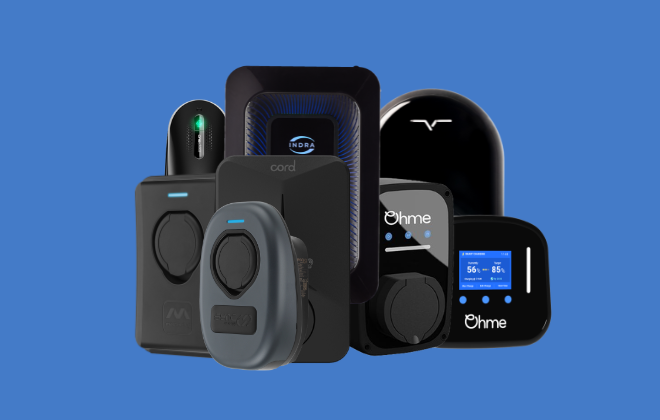
Unlike iPhone chargers, which are always almost identical, electric car chargers are not all the same. Off the bat, EV chargers have different looks, features, and sizes, but there’s one core difference that impacts everyday charging life: power outputs (kW). Or, in layman’s terms, the speed at which it charges your EV.
Certain EV chargers supercharge. Others trickle charge. Take note of the type you’re using:
- Slow
- Fast
- Rapid
- Ultra-rapid
Depending on your maximum charging rate (more on this to come below), the general rule of thumb is: the higher the EV charger’s power output (kW), the faster your electric vehicle will charge.
Case in point, using a 7kW charger will be twice as fast compared to a 3.6kW EV charger. And using a 350kW ultra-rapid public charger will be infinitely faster than a 7kW charger.
Remember: this is not always the case…see onboard charger section for more details.
3. State of charge (SoC)
State of charge means how full or empty your battery is. Picture it like an iPhone’s battery icon, displaying how much battery is left before you inch into the dreaded red.
Applying this to EV charging time, if your electric car has a 60% battery charge, the time it will take to top up your EV will be significantly less than a full charge from 0%.
Bonus tip: With any rapid and ultra-rapid EV charging station, you can charge to 80% in as little as 20 minutes. After that? The last 20% of the charge can take another 20-30 minutes to charge.
4. Temperature/Weather Conditions
Cold weather. Hot weather. Unfortunately, it can negatively impact your EV charging.
And it’s all to do with battery chemistry.
But without getting into the technicalities, all you need to know is that:
- In freezing temperatures, your EV’s battery will slow down charging to protect itself, increasing the time to charge (less than 8°C)
- During heatwaves, charging may slow down to prevent overheating the battery (more than 30°C)
So, in both cases, make sure you’re not headed anywhere in a rush and take note that charging will be that tiny bit longer.
Don’t worry about this too much; any noticeable impact is more in extreme temperatures. Think white, frosty winters and scalding hot summers.
Top tip: Optimal EV charging temperature: 15-25°C.
5. Maximum onboard charger
Inside your electric car is an onboard charger. This nifty device controls how much power your EV can take and ultimately charge with – creating maximum charging rates.
Maximum charging rates are not universal; Each electric car model has a different maximum charging rate, both for Alternating Current (AC) and Direct Current (DC).
Simply put, alternating current is for home EV charging, and direct current is faster, stronger currents used for rapid and ultra-rapid charging stations.
Certain electric car batteries can’t handle high charging rates. So, even if you charge these higher rates, you won’t charge any faster.
Let’s look at an example. The Honda e, for instance, has a maximum AC onboard charging rate of 6.6kW. Even if you were to use an 11kW EV charger at home, it would still only charge at 6.6kW.
That’s also why investing in a 22kW home EV charger is not always the best choice, too.
Explore the intricacies of onboard chargers in our complete guide.
6. Number of electric cars on charge
As the number of electric cars soars (2,280,000 to date), the number of multi-EV households is increasing (owning more than one electric car).
The choice of having two EV chargers, of course, depends on several factors, but it’s important to note that charging two electric cars at the same time can affect charging speed.
Why? It all comes down to your electricity supply and how it will be split in two to charge your EV.
For instance, a single-phase electricity supply, at roughly 7kW, will be split to 3kW between two EV chargers.
This often will impact EV charging time. In our opinion, you only need one EV charger. Simply switch when you’re done.
What’s the fastest way to charge an electric vehicle?
Without preamble, ultra-rapid EV charging stations are the fastest way to charge your electric car.
Not only do they offer high kW power rates of up to 350kW in certain areas, but since they use Direct Current (DC), you can instantly be quicker.
Note: As experts in EV charging, we don’t recommend using rapid chargers and ultra-rapid EV charging stations frequently. Using the high power outputs can damage your EV’s battery and encourage battery degradation.
Explore other tips on how to look after your EV battery life.
What’s the slowest way to charge an electric vehicle?
The slowest way to charge your electric car by far is with a 3-pin plug EV charger. Sometimes called granny chargers.
All in all, you’re looking at between 18 and 24 hours for a full charge.
With three-pin plug EV chargers, you’re missing out on smart features that can dramatically cut the cost of EV charging, as well as additional safety and aesthetic perks.
Which charging method do you recommend?
As one of the UK’s leading EV charger supply and installation companies, we would recommend charging at home with a dedicated smart EV charger.
EV tariff integration makes it cheaper. Charging during off-peak hours makes it greener. And all in all, you get safer, faster home EV charging compared to 3-pin plugs, without damaging your battery.
Want to know how long it will take to charge your electric car?
Use our quick, free time to charge calculator and find out how long it will take to charge your EV.
How to manually work it out:
Prefer the old-fashioned way? Use the following equation to work out EV charging times yourself:
EV Charging Time (Hours) = Battery size (kWh) divided by Power output (kW)
Time to charge examples:
1. Tesla Model 3: 55kW battery
Power output kW |
Time to charge |
Accepted rate? |
| 3-pin plug/2.3kW AC slow | 23 hours | ✔ |
| 3.6kW AC slow | 15 hours | ✔ |
| 7.4kW AC fast | 7.5 hours | ✔ |
| 11kW AC fast | 4.8 hours | ✔ |
| 22kW AC fast | 4.8 hours | |
| 50 kW DC rapid | 1.1 hours | ✔ |
| 150kW DC ultra-rapid | 22 minutes (up until 80%) | ✔ |
| 350kW DC ultra-rapid | 22 minutes (up to 80%) |
Maximum charging rates:
- AC: 11kW (with three-phase electricity supply)
- DC: 170kW
2. Volkswagen ID.Buzz 7-seater: 79kWh
Power output kW |
Time to charge |
Accepted rate? |
| 3-pin plug/ 2.3kW AC slow | 34 hours | ✔ |
| 3.6kW AC slow | 22 hours | ✔ |
| 7kW AC fast | 11 hours | ✔ |
| 11kW AC fast | 7.2 hours | ✔ |
| 22kW AC fast | 7.2 hours | |
| 50kW DC rapid | 32 minutes | ✔ |
| 150kW DC ultra-rapid | 32 minutes (up to 80%) | ✔ |
| 350kW DC ultra-rapid | 32 minutes (up to 80%) |
Maximum charging rates:
- AC: 11kW (with three-phase electricity supply)
- DC: 200kW
3. Electric MINI Aceman E: 38.5 kWh
| Power output kW | Time to charge | Accepted rate? |
| 3-pin plug/ 2.3kW AC slow | 17 hours | ✔ |
| 3.6kW AC slow | 10.7 hours | ✔ |
| 7.4kW AC fast | 5.5 hours | ✔ |
| 11kW AC fast | 3.5 hours | ✔ |
| 22kW AC fast | 3.5 hours | |
| 50 kW DC rapid | 46 minutes | ✔ |
| 150kW DC ultra-rapid | 33 minutes (up to 80%) | |
| 350kW DC ultra-rapid | 33 minutes (up to 80%) |
Maximum charging rates:
- AC: 11kW (with a three-phase electricity supply)
- DC: 70kW
When is the best time to charge an electric car?
In our opinion, the best time to charge an electric car is during off-peak hours with a home EV charger.
Not only is the electricity used greener, but it’s also much, much, much cheaper. Especially when you take advantage of an EV tariff.
Intelligent Octopus Go, for example, lets you charge for as little as 7.6p per kWh during these off-peak hours. Score. Discover how much you can save with an EV tariff in our electric car charging cost guide.
How long does it take to charge an EV?: Final Thoughts
Unfortunately, the time it takes to charge an electric vehicle (EV) is not one-size-fits-all. Different cars come with different-sized batteries. Different EV chargers offer different charging rates. Different weather equals a different charging experience.
But stick to these three general rules to amplify and simplify your EV charging times:
- Avoid constantly using rapid and ultra-rapid chargers; only use them when you’re going on long trips or are in desperate need of a charge, as they provide the fastest rate.
- Extremely slow and arguably unsafe, only use 3-pin plug chargers in emergencies.
- Trust home charging points for your daily charging.
Ready to take advantage of cheaper, greener and more convenient electric car charging? Invest in a home EV charger.
Shop our wide range of electric car chargers now, including full, expert installation. Alternatively, contact one of our EV charging experts at 03333 44 96 99 for unbiased, tailored advice, or discover the world of EV charger installations in our comprehensive guide.
Get complete peace of mind with We Power Your Car. Trusted. Accredited. Experienced. We handle the entire EV charger and installation process, from charger choice to DNO application, installation, and aftercare, all with first-class customer service.
Or take a closer look at our credentials:
- Safe Isolation Provider
- ISO accredited (ISO 9001, ISO 14001 and ISO 45001)
- OZEV-approved
- NICEIC approved
- Safe Contractor Approved
- HERS accredited
- 40,000 installations
Stay connected for the latest EV news, offers, and updates by following us on Facebook, Twitter, LinkedIn and YouTube.